introduction

Dams are structural barriers built to obstruct or control the flow of water in rivers and streams. They are designed to serve two broad functions. The first is the storage of water to compensate for fluctuations in river discharge (flow) or in demand for water and energy. The second is the increase of hydraulic head, or the difference in height between water levels in the lake created upstream of the dam and the downstream river
By creating additional storage and head, dams can serve one or more purposes:
-
Generating electricity
-
Supplying water for agricultural, industrial, and household needs
-
Controlling the impact of floodwaters; and
-
Enhancing river navigation
They can be operated in a manner that simultaneously augments downstream water quality, enhances fish and wildlife habitat, and provides for a variety of recreational activities, such as fishing, boating, and swimming

Classes of Dams
Four major classes of dams are based on the type of construction and materials used: embankment, gravity, arch, and buttress.
Embankment
Embankment dams typically are constructed of compacted earth, rock, or both, making them less expensive than others that are constructed of concrete. Consequently, more than 80 percent of all large dams are of this type. Embankment dams have a triangular-shaped profile and typically are used to retain water across broad rivers
Gravity
Gravity dams consist of thick, vertical walls of concrete built across relatively narrow river valleys with firm bedrock. Their weight alone is great enough to resist overturning or sliding tendencies due to horizontal loads imposed by the upstream water
Arch
Arch dams, also constructed of concrete, are designed to transfer these loads to adjacent rock formations. As a result, arch dams are limited
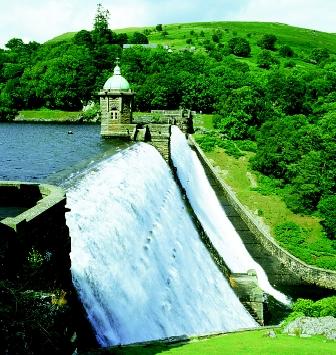
to narrow canyons with strong rock walls that can resist the arch thrust at the foundation and sides of the dam
Buttress
Buttress dams are essentially hollow gravity dams constructed of steel-reinforced concrete or timber

karun 3 dam, IRAN
Planning for Dams
Careful planning throughout the siting, design, and construction of dams is necessary for optimal utilization of rivers and for preventing catastrophic dam failure. These planning phases require input from engineers, geologists, hydrologists, ecologists, financiers, and a number of other professionals
Designers must first evaluate alternative solutions and designs for meeting the same desired objective, whether the goal is to allocate water supply, improve flood control, or generate electricity. Each alternative requires a comprehensive cost-benefit analysis and feasibility study for evaluating its physical, economic, ecological, and social impact
Once an alternative has been selected, a number of important considerations enter into the design and construction of the dam. These include
-
Hydrological evaluation of climate and streamflows
-
Geologic investigation for the foundation design
-
Assessment of the area to be inundated by the upstream lake (also called a reservoir) and its associated environmental and ecological impacts
-
Selection of materials and construction techniques
-
Designation of methods for diverting stream flow during construction of the dam
-
Evaluation of the potential for sediments to accumulate on the reservoir bottom and subsequently reduce storage capacity; and
-
Analysis of dam safety and failure concerns
When a dam is put into operation, or commissioned, water is released from the upstream reservoir over a spillway or through gates in a manner to satisfy intended objectives. Operating rules for maximizing power generation, for example, include maintaining hydraulic head. In contrast, water levels in flood control reservoirs must be periodically reduced to allow for new storage during anticipated periods of flood hazard. Operating issues, however, can easily become complex and highly politicized and may be difficult to resolve. This is particularly true for river systems containing several reservoirs, for dams serving multiple purposes, and in cases where adverse social, ecological, and environmental impacts are significant

Overview of Dam-Building
The first dam for which reliable records exist was built on the Nile River sometime before 4000 B.C.E. near the ancient city of Memphis. Remains of other historic dams have been located at numerous sites bordering the Mediterranean Sea and throughout the Middle East, China, and Central America. The oldest continuously operating dam still in use is the Kofini Dam, which was constructed in 1260 B.C.E. on the Lakissa River in Greece
Today, there are approximately 850,000 dams located around the world. Of the more than that are categorized as large dams, more than half are located in China and India. It is estimated that 24 countries currently generate more than 90 percent of their electrical power from dams, and 70 countries rely on dams for flood control
Dams in the United States
Large-scale construction of dams occurred in the United States during the post–World War II years and reached its peak in the 1960s. The organizations that have been primarily responsible for dam-building are the U.S. Army Corps of Engineers, the Bureau of Reclamation (part of the U.S. Department of the Interior), and a number of public and private utility developers
Since the nineteenth century, the U.S. Army Corps of Engineers has been engineering rivers to accommodate river traffic, control floods, produce electricity, and provide irrigation waters. Four of the largest dams
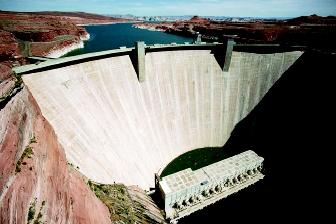
Arizona's Glen Canyon Dam on the Colorado River shows the curvature in arch dams that provides structural stability. The rock walls of the deep canyon absorb a majority of forces that result from the upstream reservoir, Lake Powell
constructed by the Corps include Garrison, Oahe, Fort Peck, and Fort Randall Dams
The second group, the Bureau of Reclamation, was established in 1902, when Congress passed the National Reclamation Act. The Bureau was initially charged with developing irrigation and power projects in seventeen western states and has been responsible for the construction of more than six hundred dams and reservoirs, including the massive Hoover, Shasta, Glen Canyon, and Grand Coulee Dams
The third organization responsible for dam construction encompasses various power administrations, such as the Tennessee Valley Authority, the largest public power company in the United States, as well as others operating under the Federal Power Act of 1920, which provided for the licensing of privately built dams to produce electric power. In part because of this mid-twentieth-century dam-building era, the U.S. dam population has approached 75,000. More recently, however, the rate of dam construction in the United States is exceeded by the rate of decommissioning. In many cases, maintenance costs for aging infrastructure, significant social and ecological impacts, high construction costs, and the reduced availability of suitable sites have made alternatives to dams more viable

2.jpg)
 با سلام خدمت دوستان عزیز امیدوارم که حداقل تو اون مدتی که از این وبلاگ استفاده میکنید حوصلتون سر نره. این وبلاگ توسط گروهی از دانشجویان دانشگاه صنعتی سهند راه اندازی شده است و هدف ما از راه اندازی این وبلاگ معرفی هرچه بیشتر علم مهندسی معدن به خدمت شما عزیزان میباشد که امیدواریم خوشتون بیاد .